Sunday, October 16, 2011

Sports and the gendered bodies: Google search

There is not exactly one picture that captures the gendered bodies idea so I'm going to post a few pictures and explain my process behind this idea. First off I did a general sports image search in google and it came up with icons but if people were in the pictures it was mostly basketball teams or male sport teams. Then I typed in women in sports and got this image...


I don't know where she plays sports or who she is... but it doesn't look like she is playing a sport at least not in this picture. Then I google'd men in sports and got this image...(and may I add that there were still girls in bikins on this page)
I got a quarterback, and a bunch of sports apparel, so a lot of less nude women. I then decided to go one step further in my search and looked for specific people. I searched Danica Patrick (Women NASCAR driver)
Well she is near a car.... but I don't think they drive in that kind of apparel. Basically all of her pictures were something like this. Then I searched a male figure, Aaron Rodgers (Quarterback of the Superbowl champions, the Green Bay Packers)
All of his pictures were like this.
Gender bodies; the males are all "strong bodies" and women are pretty much all shown as dainty "weak bodies" not that the women's bodies aren't strong and in shape but they are inferior to men bodies; to make a more general statement, men sports are better then women's. All of the male photos are action photos, they are doing their sport in uniform and have an aggressive look on their face. While the women are in sexy poses and the least amount of clothing. I can make a lot of connections from this, one really important one is something we repeatedly talk about it class, women are always portrayed as sexual objects, in the Adam and Eve picture Robin showed in class the women (Eve) who was painted as a taunting sexual object while the man (Adam) seeks her. That is interesting because in the painting it seems as if the women (in my opinion) has more leverage, she is the one with the power here; however, current day the objects (women) are looked down upon and have a lack of power. Stuart Hall states "The use of classification as a system of power... via gender... assumption that you can predict whole ranges of behavior, opportunities and aspirations." While we as a culture classify what is a strong and weak body we also set stereotypes and standards for athletes men and women alike. Our culture still adds to a gender barrier dating back to Adam and Eve, women are inferior. The politics behind this give men the upper-hand everywhere, not just sports. Our culture still faces gender discrimination, the signifier, men signifies strength, power, wealth whereas women on the other hand signify sexuality, need for men, innocence and weakness. I've found from this google search that our culture really views men in a more respectable manner, (not that you can't find pictures of half-naked or completely naked men) women are shown more often in a sexual manner then men.

Saturday, October 15, 2011

Settling In

This picture is a representation of raced bodies that has a clear subject position. First off, notice the difference between the strong bodies (the Israeli Defense Force Soldiers) and the weak bodies (the white protesters). The angle the picture is taken at gives the soldiers a more imposing feel, thus signifing that the soldiers are higher up in the system of power. Not that they need any more help looking imposing since they are wearing kevlar body armor and helmets, as well as being armed with hand guns and M4 Carbines. M4 Carbines are used specifically in urban settings since they have a smaller barrel than a rifle along with a colapsable butt stock for easier movement in cramped spaces. They also shot at a faster rate than an M16. The soldier's face who is looking at the protesters is one of smugness and a 'don't move or we'll bring you more pain'. The protesters have clearly been huddled together so as to keep a better eye on them. The white person with the dreads covering his/her (I can't tell) face seems to have been pepper sprayed. Military grade pepper spray has a higher oliresan capsicum percentage than pepper spray you can buy in the store for self defense. Having been pepper sprayed before for security training I can attest to the pain it brings lasting anywhere from 8 hours to 24 hours with rare occurences of relapsing pain. The protesters are trying to stop Israeli settlers from taking land that had belonged to Palestinians before Israel became a country again in 1948. The protesters, unfortunately, by being classified as white have a greater effect on me since we share the same race, than if they were a race different than my own. By identifying with them, I have a greater cause of concern that 'settling' is unjust. The Settlers move into the West Bank or East Jerusalem and 'settle' or 'squat' in a Palestinian's home and claim it as there own forcing the former owners out. Having personally seen Settlers take over another family's dwelling in the Sheik Jarrah neighborhood of East Jerusalem is a heinous sight that makes you notice that through 'supperior' power, class, and race you can do whatever you choose with no repercusions. Israel is the highest recipiant of U.S. forgein Aid and Egypt was number 2. It will be interesting to see in the coming years how foreign aid to Egypt will change now that Hosni Mubarak, the former President of Egypt, is no longer in power. Mubarak was the only Middle Eastern leader who had a peace agreement with U.S. backed Israel which is no longer acknowledged by the Egyptians.

Friday, October 14, 2011

Is Vogue Racist?

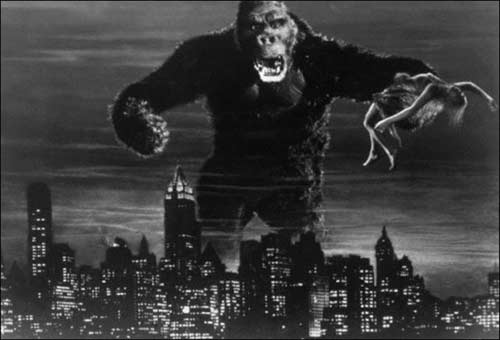
I think this image can be used to analyze raced bodies, gendered bodies, and classed bodies. I will start with raced bodies. This image directly plays semiotics (something only has meaning in relation to something else) the fact that you can’t have black without having white, and that the white body (especially in this picture) is seen as absent and neutral. As Stuart Hall said that classification is a fundamental aspect of human culture, this classification system in today’s society is used as a system of power. When looking at Lebron you see the representation of the black body as being animalistic, huge, and mean. It is clear in this image that although Lebron is a big guy he is slouched over and screaming possibly even roaring giving him an animalistic representation almost ape-like (Darwinism picture below). This picture induces that social dawinism making the black body appear less evolved. You also see in this image that Lebron is an athlete, which classifies him as uneducated. He may be successful however in the sense of this classification he still would not be considered upperclass; to be considered upperclass he would need to be wearing a business suit rather than nikes. If you then look at Giselle you see the difference between black and white and the difference between male and female in today’s society. She is dainty, thin, happy, and well dressed. She signifies an upperclass, white, female who makes a living not by getting sweaty and dirty but instead by looking good for others (other oriented society). Lebron in the picture looks takes up almost three times the amount of space as her, a real representation on how men are supposed to be present in society and women are supposed to be taking up absent. I also like to note that the Giselle the white female looks happy and carefree where as Lebron the black male looks like he is in terror. The image as shown in the cartoon shows Lerbron taking control over and actually grabbing onto Giselle. I think this really shows the way that culture uses the black and white bodies to portray what they think and how they feel. The black body is usually represented as being distressed in one way or another. It is interesting to take note that although on the cover Giselle is gorgeous and skinny the magazine advocates “dressing for any size” but then also advertises diets. The diets advertising are targeting the societies idea of an intelligible body. The ads that talk about dressing for any size kind touch on what Stuart Hall said that something is disturbing once it breaks the classification this ad is trying to turn women whose bodies are not intelligible by size into intelligible looking bodies. I decided to do some further research to see if others found this cover as offensive as I did and as a matter of fact I came across many pictures and many articles. Comments said things like why isn't Lebron in a suit and that the editors of Vogue in fact had a much more 'civilized' picture of the two that they could have used instead. Sorry for all the images but I couldn't help but add the other ones I found below.


Social Darwinism


kingkong_1933_01.jpg


The image they didn't choose to use...


Thursday, October 13, 2011

Posting Assignment #4 (due Sunday 10/16, 11:59 P.M.; comment by 11:59 Monday, 10/17) ‘Raced,’ ‘Classed’ and other bodies and their politics


When we looked at the 1907 World’s Fair Catalog with its declining series of humans trailing down to the ‘Negro’ and ‘Prehistoric Man’ at the bottom, many of us visibly cringed; the politics were obvious and harsh.

But we’re making a stronger claim: that all representations of the body do political / cultural work, and the operations of that work are not always obvious at all.  And worse: if Richard Dyer is right (and he is), the racial, class and other attributes of white bodies are invisible.  White is natural, normal—and anchors that ‘hegemony’ we talk about.


This image was circulated by the Associated Press in a story that appeared across the world about ‘riots’ in Kenya.  Robin got it from his good friend Wahutu Siguru, a Kenyan who hold a law degree and is a doctoral student in our Sociology Department.  Wahutu said it simply reproduced the West’s view of Africans—and that the ‘riots’ were not the way the press reported.  He knew; he talked with his family and friends.  Wahutu corrected things (a bit) on his Facebook page. 


This is ‘Politics of Representation.’  And also the politics of the news.

Wahutu’s body responded very differently from Robin’s.  How bodies respond—going ‘OK,’ or cringing, or saying ‘yeah, that looks right,’ or whatever—are data for cultural analysis.

And we can read the image:  a black man in scanty dress is jumping (‘dancing’?) on the roof of a rusted burned-out car.  An oily fire burns in the background.  A broken telephone pole in the background is perfectly aligned with the man’s hand—and looks like a spear.

  • Find an image of a raced, classed, gendered,… (whatever) body.
  • Post it to the Blog and Read it, using our materials and methods
  • Read (or otherwise use) your body’s reaction (maybe letting Dyer’s account guide you) 
          and use all of this to:
  •  Analyze the Politics of Representation going on with the image.  What’s the ‘political / cultural work’ it’s doing to construct our view of the world and those bodies that inhabit it? 

Use any format that works for you.

Sunday, October 2, 2011

Shades and Headphones

One body practice that I have noticed that has been made even more popular with the invention of mp3 players and smartphones with enough memory to store music files is people in a public place, is for people to be, or at least give off the appearance that they are, completely tuned out with what is going on around them. Before these devices some people would read books or bring something like a yo-yo to tune everyone else out, but now almost everyone has access to some sort of mobile music device. This signifies to everyone else around them that they are not paying attention and most likely do not want to talk to you. I do the same thing with sunglasses. I cleaned pools over the summer and when you have sunglasses on that make it so people can't see where you're looking they tend to give you a little bit more respect or try to hold your attention more because they don't know if you're looking them in the eye or starring off into space. I like knowing that people can't see my eyes because it lets me pay more attention to the details of their body language, without coming off as creepy. I also like to watch the people that go by me when walking down a sidewalk or across the Washington bridge as something to do instead of just look straight forward and pretend to not be noticing anything that is going on besides what people are doing right in front of me. I also notice that when talking to someone and you have sunglasses on and they don't they tend to try to not make as much eye contact, and by another body practice to give the impression that they are less interested in what you are saying, or in holding your attention since they get the feeling that you aren't paying as much attention or might be worried that they aren't holding your attention. Body practices that come up when having a conversation with someone always interest me since there are so many small actions or body movements that can change how a conversation is perceived by one person, or what one person is trying to signify to another person while talking to them.
An increasingly interesting body practice that I have been noticing is the heightened levels of procrastination in today's youth. Much of this could be attributed to the culture of emails texts and instant messaging that we have grown up with. For example, when searching for a primary source one can simply sit down and have access to the largest database of information in the world in mere seconds, it's easy to see how this technology could affect young people in a negative way. The decline of grammar in every day language is increasingly apparent with more and more conversations on the sidewalk consisting of phrases such as "omg" "lol" and "roflmaosastty?" In a generation where information is available to an individual within seconds could it be that that individual is less inclined to work as hard as a member of an older generation? Or could it be the changing world has changing work habits in it, could our culture be morphing to the point where people truly do have to work less? That has always been the intent of technology, but at what point may it become too much. Once again the body practice I noticed was increased levels of procrastination in my roommates, friends and even myself. I do not know the exact reason for this, though my guess and my argument is that increased levels of technology could be the cause. Please comment with any other ideas on the matter.

I think curves are hot but why isn't it normal?


A common body practice, especially for white women, is going through some type of dieting. I say white women because when I was watching tv today, most of the commercials and adds about losing weight all had white models. It seems that we are socially constructed to believe dieting is to become as thin and slim as possible. I then thought about people who are still considered beautiful in our society. For example, Beyonce and Jennifer Lopez are two very curvy, not white women. Jennifer Lopez was also voted the most beautiful woman of 2011 by People Magazine. The point here is that a lot of American women are dieting to become slim because most of the advertisements we are used to seeing involve becoming the skinniest person possible. America needs to realize that being that skinny is not always beautiful, even though the praxis of dieting is a common body practice in today's society